
REPORTING Animal Cruelty
PLEASE SPEAK UP! You may save a life.
Pennsylvania SPCA (PSPCA) Cruelty Hotline 1-866-601-SPCA (7722)
Note that this hotline receives calls from anyone concerned about an abused or neglected animal or group of animals, including farm animals. The PSPCA has Humane Law Enforcement officers assigned to specific counties to investigate and prosecute cruelty or neglect cases in conjunction with local law enforcement agencies.
Callers are encouraged to provide all information requested, especially a specific address where the animal(s) is located for purposes of investigation. Callers can request to be listed as anonymous but must still provide their contact information to the PSPCA for the assigned officer to call for more information as needed.
The Pennsylvania SPCA (PSPCA) Cruelty Hotline ALSO has an online REPORTING FORM at https://www.pspca.org/form/report-animal-cruelty that can be used to report any animal cruelty or neglect for intervention by the PSPCA Humane Law Enforcement Officers.
What is Animal Cruelty?
A summary of Pennsylvania’s animal cruelty laws
The Pennsylvania SPCA enforces the animal cruelty laws of the Commonwealth in 23 counties. Under Pennsylvania law, cruelty to animals includes:
Neglect of animal, including failure to provide:
- Food and water
- Clean and sanitary shelter and protection from weather
- Necessary veterinary care
Cruelty to animal: A person commits an offense if the person intentionally, knowingly or recklessly illtreats, overloads, beats, tortures, abandons or abuses an animal.
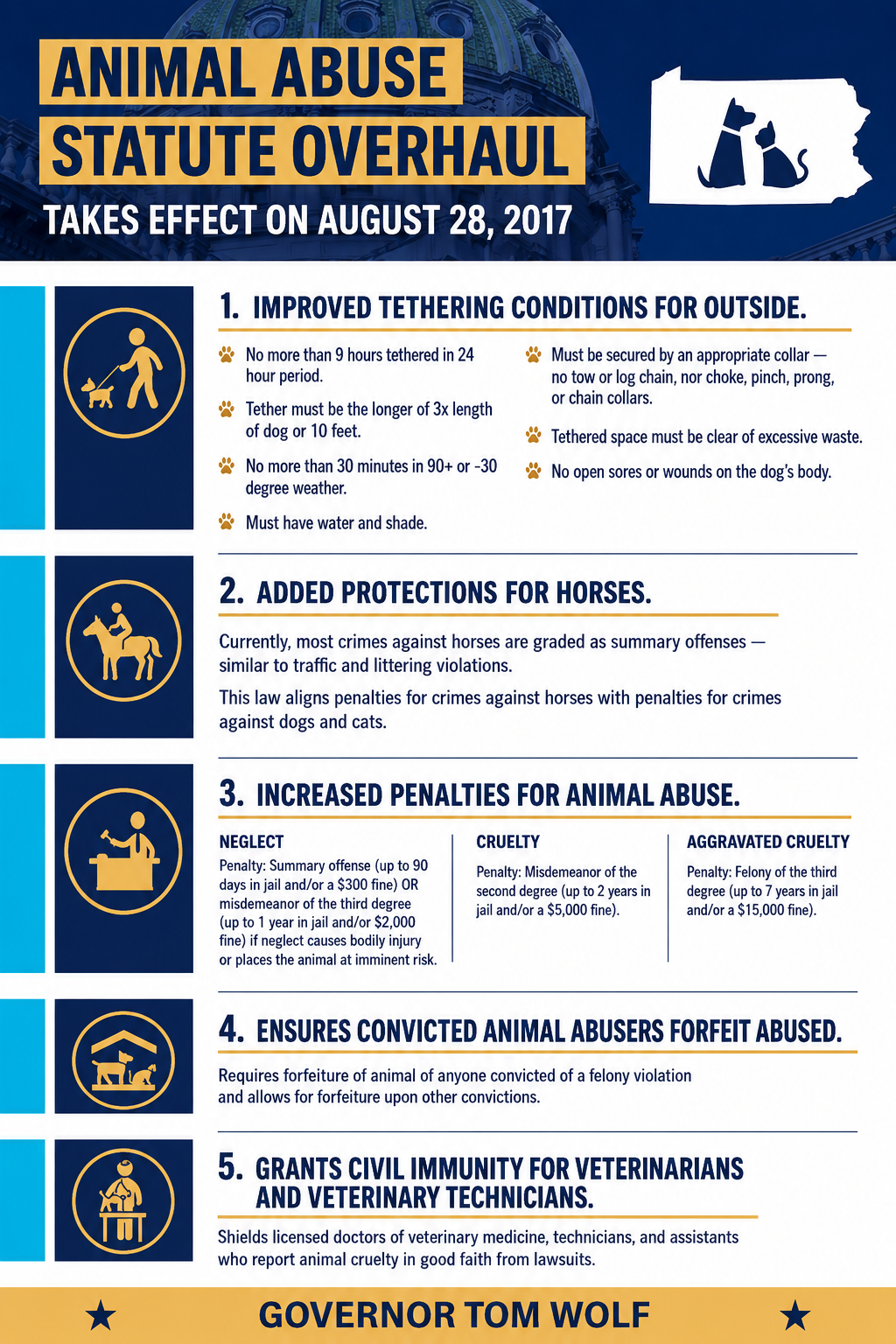
Tethering of unattended dog. An unattended dog may only be tethered for nine hours or less in a 24-hour period, and must meet the following criteria:
- The tether must be of a type commonly used for the size and breed of dog and is at least three times the length of the dog as measured from the tip of its nose to the base of its tail or 10 feet, whichever is longer.
- The tether must be secured to a well-fitted collar or harness by means of a swivel anchor, swivel latch or other mechanism designed to prevent the dog from becoming entangled.
- The tethered dog must have access to water and an area of shade to escape the direct rays of the sun.
- The dog may not be tethered for longer than 30 minutes in temperatures above 90 or below 32 degrees Fahrenheit.
Transporting animals in cruel manner.
Animal mutilation and related offenses, including:
- Cropping of ear.
- Debarking
- Docking of tail
- Surgical birth
- Dewclawing of a dog
Animal fighting.
- Causing or allowing an animal to engage in animal fighting
- Receiving compensation for the admission of another person to a place kept or used for animal fighting
- Owning, training, promoting, purchasing or acquiring in any manner or knowingly selling an animal for animal fighting
- Wagering on the outcome of an animal fight
- Attending an animal fight
- Knowingly permitting a place under the person’s control or possession to be kept or used for animal fighting
Possession of animal fighting paraphernalia.
Taunting or abusing Police animals.
Below is Pennsylvania’s law on animal cruelty and the contact information for the Pennsylvania SPCA Cruelty Hotline.
Animal cruelty can range from simple neglect to outright physical violence against an animal. In any case, animal cruelty is always wrong and should be reported to your local authorities.
It is important to know that pet owners not only have a moral obligation but a legal obligation to properly care for their animals. If you see or hear of animal cruelty,
PENNSYLVANIA LEGAL PROTECTIONS FOR ANIMALS:
What is the Pennsylvania law regarding animal cruelty?
Pet owners have not only a moral obligation but a legal obligation to properly care for their animals.
Title 18-Section 5511(c) of the Pennsylvania Anti-Cruelty Law: Cruelty to Animals. – A person commits a summary offense if he wantonly or cruelly ill-treats, overloads, beats, otherwise abuses any animal, or neglects any animal as to which he has the duty to care, whether belonging to himself or otherwise, or abandons any animal, or deprives any animal of necessary sustenance, drink, shelter or veterinary care, or access to clean and sanitary shelter which will protect the animal against inclement weather and preserve the animal’s body heat and keep it dry.
Pennsylvania Animal Abuser Registry — SB 213 Overview
Pennsylvania Senate Bill 213 (2019) created the Animal Abuse Registry under Title 44 of the Pennsylvania Consolidated Statutes, Chapter 25. The law established a statewide database maintained by the Pennsylvania State Police to track individuals convicted of certain animal abuse offenses PA Legislature.
Key Provisions
- Eligible Offenses:
- Violations of 18 Pa.C.S. § 5534 (aggravated cruelty to animals).
- Other felony animal protection violations in Pennsylvania.
- Similar offenses under U.S. or foreign law if the offender is domiciled in PA PA Legislature.
- Information Sources:
- Clerk of Court: Must forward a certified copy of a judgment, guilty plea, or nolo contendere to the State Police within 60 calendar days.
- State Police: Receive and consolidate information from all jurisdictions PA Legislature.
- Registry Contents:
- Name, date of birth, and conviction details of individuals placed on the registry.
- Information is entered after receipt from courts or other jurisdictions PA Legislature.
- Maintenance:
- The State Police maintain the registry and make it publicly accessible.
- Records are retained for the duration of the offense’s statute of limitations, with provisions for expungement under certain conditions PA Legislature.
Purpose and Context
The registry aims to:
- Protect animals by making convicted abusers’ information available to shelters, rescuers, and the public.
- Deter repeat offenses by limiting access to animal adoption and purchase by those on the list.
- Support enforcement of existing penalties for aggravated animal cruelty, which in PA became a felony in 2017 ABC27+1.
Similar Laws
At least a dozen states and local governments have animal abuser registries. Tennessee was the first state to adopt a statewide one in 2015, and Florida’s “Dexter’s Law” (2023) created a public searchable database for felony animal cruelty offenders ABC27+1.
Current Status
The 2019 SB 213 law is in effect, but recent legislative research shows that a newer version of SB 213 (2025–2026) has been introduced with a different focus — recognizing two sexes and providing duties/prohibitions — and is not the animal abuse registry bill LegiScan. The animal abuse registry provisions remain under the 2019 law.
In summary: PA SB 213 (2019) created a public, state-wide animal abuse registry maintained by the Pennsylvania State Police, tracking individuals convicted of felony animal cruelty offenses, with the goal of protecting animals and preventing repeat abuse PA Legislature+1.
‘Victoria’s Law’ aims to stop the sale of animals raised in puppy mills in PA.
(This is an update of the ongoing legislation in Pennsylvania )
By: Peter Hall-February 24, 2026 – Published by The Pennsylvania Capital Star Newspaper
Under a new proposal in the State House, pet stores in Pennsylvania would be barred from selling animals from large-scale breeders, described by critics as puppy mills, where dogs kept for breeding often endure years of inhumane treatment.
Supporters say Victoria’s Law, named for a German shepherd rescued from a Lancaster County kennel after a decade of breeding, would help consumers by requiring more transparency and higher standards in the pet trade, while ensuring a better quality of life for countless animal companions in the commonwealth.
“ House Bill 1816 can reduce the risk of heartbreak and financial strain for Pennsylvania families, improve the overall safety and health of pets entering homes and empower consumers to make more informed, ethical choices,” said Grace Kelly Herbert, founder of Finding Shelter Animal Rescue in Norristown.
Critics say the measure doesn’t do enough to tackle the root of the problem with unregulated breeders and that the same goals could be achieved by strengthening and enforcing Pennsylvania’s dog law. Dr. Andrea Honigmann, president of the Pennsylvania Veterinary Medical Association, said the bill would do nothing to increase penalties for unlicensed kennels, meaning it would not affect those already operating outside of the law.
“We are in the trenches, observing firsthand, sometimes the appalling and irresponsible keeping, kenneling and breeding of pets,” Honigmann said. “The reality is that these woeful animals can and do come from anywhere, including private breeders and rescues, and not solely from pet shops.”
The bill, which was the subject of a hearing before the House Consumer Protection, Technology and Utilities Committee, is sponsored by state Rep. Jeanne McNeill (D-Lehigh). McNeill said she has pursued reform in the State Department of Agriculture’s regulation of commercial pet breeding for more than eight years. Sen. James Malone (D-Lancaster) sponsored companion legislation this month.
“Pennsylvania, and Lancaster specifically, have a puppy mill problem,” Malone said in a statement. “These facilities are forcing dogs to breed under inhumane conditions. They’re overwhelming the shelter system and producing dogs that often have genetic and other health issues, which are costly and devastating for owners.”
Malone said bills would reduce market demand for such inhumane operations and encourage retail pet dealers to source animals from reputable breeders and shelters.
The proposal would bar the issuance or renewal of pet-shop-kennel licenses under the Dog Law after this year. A similar provision would apply to licenses to sell cats and rabbits.
After hearing testimony, Rep. Carl Metzgar (R-Somerset), the committee’s ranking Republican, noted the issue of dog breeding has historically been addressed by the Agriculture Committee and recommended re-referring the bill to that committee for consideration. The Consumer Protection, Technology and Utilities Committee took no votes Tuesday.
Pennsylvania has for years been ranked among the states with the most dog breeders and sellers cited by regulators, according to Humane World for Animals, formerly the Humane Society of the United States. The group publishes a “ Horrible Hundred” report on the most egregious violations each year.
In the 16 years since founding her shelter, Herbert said she’s had hundreds of positive and negative experiences helping families find pets. She’s also rescued around 10,000 dogs and puppies, including some from pet stores and breeders that died hours or days after they were rescued.
On the table as she testified Tuesday were two small boxes containing the ashes of puppies Bert and Tyler, who died despite receiving nearly $10,000 in veterinary care after they were rescued from a pet shop. While Pennsylvania law protects consumers who purchase animals with hereditary or congenital defects, it allows only 10 days after a purchase for a new pet owner to receive a diagnosis.
“All I could think and imagine was if this was an unsuspecting family with children whose new puppy died,” Herbert said. “I have the heart and soul of a seasoned rescuer, and let me tell you, this was not easy … Had those people taken them home, they would have had a tragedy in their family.”